CAGLIARI ◉ SARDINIA ◉ 2026
Sant'Efisio
The Feast of Sardinia
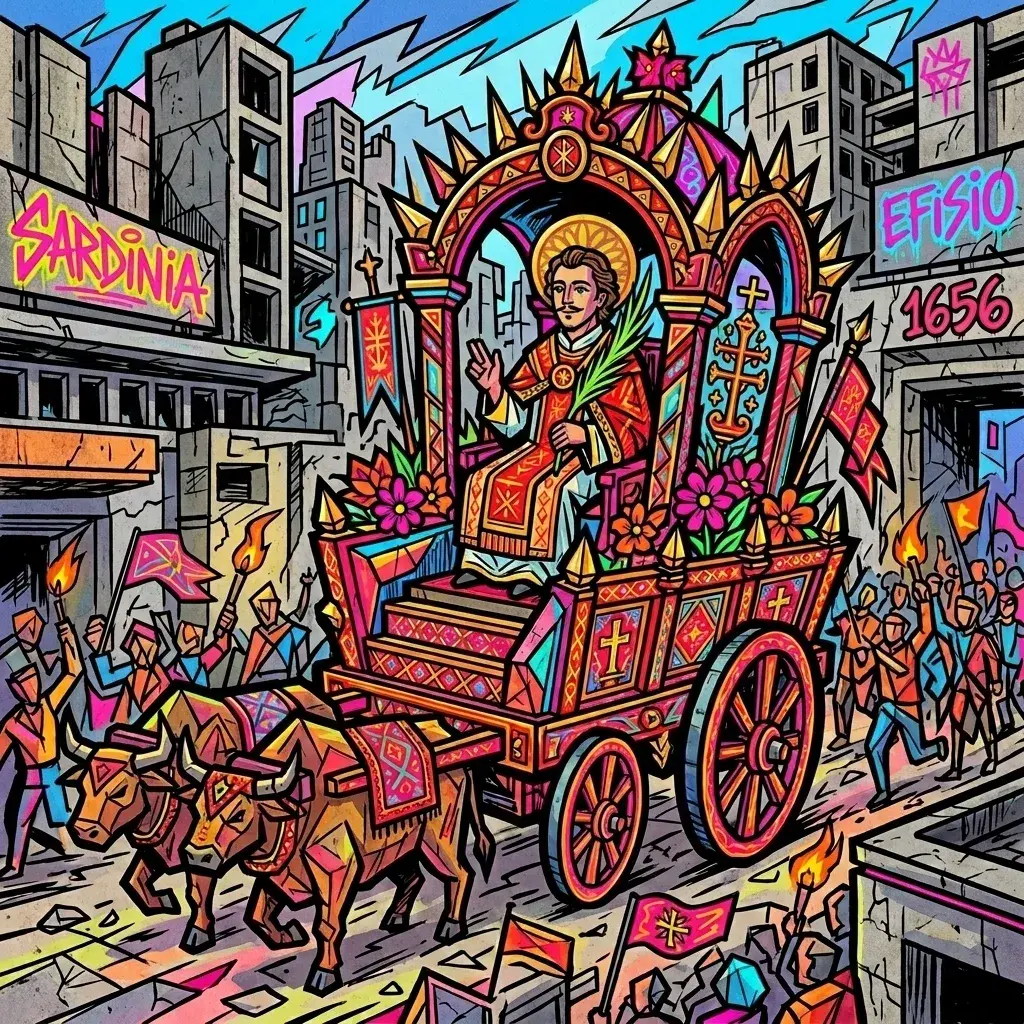
The largest religious, cultural and identity event in Sardinia — 370 consecutive editions, never once interrupted.
370
Consecutive Years
3,000
Costumed Participants
100 km
Round trip · 4 days
200+
Horsemen
What Is the Feast of Sant'Efisio?
Every year from May 1st to 4th, the city of Cagliari fulfills a vow made in 1652 during a devastating plague epidemic. In exchange for the saint's intercession, the city promised to honor Sant'Efisio with a solemn procession — every year, forever.
That promise has been kept 370 times without exception — through wars, bombardments, and even pandemic. In 2020 and 2021, the procession was held in reduced form rather than cancelled.
The procession covers 100 km on foot over four days, from the church of Stampace in Cagliari to the ancient Romanesque chapel at Nora — the beach where Sant'Efisio was martyred in 303 AD — and back.
The Vow of 1652
On July 11, 1652, the city authorities of Cagliari solemnly vowed to honor Sant'Efisio every year on May 1st — in exchange for protection from the plague that had killed nearly 10,000 people. The epidemic ended in 1656. The first solemn procession was held in 1657. It has never stopped since.
UNESCO Candidate
The Feast of Sant'Efisio is an official candidate for UNESCO Intangible Cultural Heritage status — recognized for its unbroken continuity, its mobilization of an entire society, and its unique blend of religious devotion and living folk tradition.
The Four-Day Procession
Departure from Cagliari
The golden chariot pulled by white oxen departs from the church of Stampace at noon. The procession winds through Cagliari, pausing at the Palazzo Civico on Via Roma — church bells ring across the city, ships in the harbor sound their sirens. The road is covered in fragrant flower petals: sa ramadura.
Toward Nora
The procession continues south through Sarroch, Villa San Pietro, and Pula. In the evening, the statue of Sant'Efisio arrives at the ancient Romanesque chapel of Nora, built on the very beach where he was beheaded 1,700 years ago.
Celebrations at Nora
A full day of Masses and celebrations at Nora. In the evening, a solemn procession moves from the chapel through the Roman archaeological ruins toward the beach of the martyrdom — a uniquely atmospheric ritual where ancient history and living faith converge.
The Return to Cagliari
The procession retraces the 40 km back to Cagliari. Around midnight, the statue of Sant'Efisio re-enters the church of Stampace. The president of the Arciconfraternita reads the official fulfillment of the Vow. The crowd responds with the traditional cry: "A atrus annus!" — "Until next year!"
Who Was Sant'Efisio?
According to the Passio, Efisio (Ephysius) was born around 250 AD at Aelia Capitolina — the name Rome gave Jerusalem after 135 AD — and was later presented at Diocletian's court in Antioch. His father was Christian, his mother pagan. Orphaned young, he was educated in pagan cults and eventually joined the Roman imperial army under Emperor Diocletian.
While leading his troops through Italy on a mission to persecute Christians, Efisio experienced a sudden mystical vision: a cross of crystal blazing in the sky and a voice that said "I am Christ, whom you persecute." A cross imprinted itself on his right palm. He converted, was baptized at Gaeta, and began preaching the Gospel.
Transferred to Sardinia to fight the rebellious Iliesi tribes, he continued evangelizing. He wrote a letter to Diocletian confessing his faith and inviting the Emperor to abandon the false gods — an act of spectacular defiance.
He was arrested, imprisoned in a cave below what is now the church of Stampace, tortured, and beheaded on the beach of Nora on January 15, 303 AD. His last prayer, according to tradition, was for the protection of Cagliari and its people — a promise he has apparently been keeping for over 1,700 years.
The Sensory Experience

Sa Ramadura
The procession route is covered with fragrant herbs and flower petals — pink, red, yellow. Trampled by oxen, horsemen and 3,000 costumed participants, they release an intense perfume into the air and paint the streets in a living carpet of color.

Launeddas
The haunting sound of the launeddas — one of Europe's oldest wind instruments, capable of creating continuous polyphony on a single breath — threads through the entire procession. It is the unmistakable sonic signature of the feast, evoking an ancient, emotionally overwhelming atmosphere.

Is Goccius
Devotional hymns in Sardinian language, sung by four-part male choral formations called a cuncordu. Each voice is performed by a single specialist singer belonging to a lay confraternity. Combined with the launeddas, they create a sacred polyphony found nowhere else in European religious music.
Visiting in 2026
When & Where
Best Spots to Watch
Explore the Feast
The History →
From the 1652 plague to today — 370 unbroken editions
The Route →
100 km from Cagliari to Nora — and back — in 4 days
Programme 2026 →
Day-by-day schedule — May 1 to 4
The Relics →
900 years in Pisa, back in Cagliari since 2011
The Heritage →
Launeddas, costumes, statues — the UNESCO bid
How to Attend →
Practical guide for visitors and pilgrims